Last updated 2026-07-25
TL;DR
Lyophilized tesamorelin powder is stable frozen or refrigerated until its labeled expiration date. Once mixed with bacteriostatic water, refrigerate it at 2-8°C (36-46°F) and use it within the manufacturer's stated window (Egrifta SV labeling specifies use within 14 days of reconstitution). Never leave a reconstituted vial at room temperature or freeze it after mixing.
How should unmixed tesamorelin powder be stored?
Before it touches water, tesamorelin is a freeze-dried (lyophilized) powder in a sealed vial, and it is the most stable form of the peptide you'll ever handle. The FDA-approved product, Egrifta SV (tesamorelin for injection), is a synthetic 44-amino acid analogue of growth hormone-releasing hormone [1][2]. Like most peptide drugs, it degrades faster in heat, light, and moisture than it does sitting cold and dry. Unopened, unmixed vials should go in the refrigerator at 2-8°C (36-46°F) as soon as you get them. Some compounded versions ship with instructions allowing brief room-temperature storage or freezer storage before use, but the safest default for any lyophilized peptide is refrigeration, not the counter and not the freezer door where temperatures swing every time it opens. Don't stockpile powder at room temperature 'just for convenience.' Peptide bonds break down faster in warmer conditions, and GHRH analogues in particular are known to require careful handling. One pharmacology review of tesamorelin's population pharmacokinetics noted the drug's clearance and distribution behavior is sensitive to formulation and handling conditions in ways that matter for consistent dosing . Sloppy storage doesn't just waste money, it can mean you're injecting a weaker dose than you think without any way to tell by looking at it.
What's the shelf life of tesamorelin before mixing?
For the FDA-approved product, the manufacturer's labeled expiration date on the vial is the real answer. That's set by formal stability testing the manufacturer submitted to FDA as part of approval, and it's specific to their formulation, packaging, and lyophilization process, not a peptide-in-general number. Compounded tesamorelin sold through 503A and 503B pharmacies operates under a different framework. Compounding pharmacies are permitted to use tesamorelin as a bulk drug substance when it appears on FDA's applicable bulks list [3][4], and those pharmacies assign their own beyond-use dates based on USP compounding standards, batch testing, and their own stability data, not the brand-name product's labeling. That means beyond-use dating on a compounded vial can differ meaningfully from Egrifta SV's expiration date, sometimes shorter. Always check the specific date printed on your vial rather than assuming a generic 'peptides last two years' rule. As a general rule across the industry, unopened lyophilized tesamorelin refrigerated properly is commonly dated for something in the range of 24 months from manufacture, but that figure comes from typical peptide stability practice, not a single number you should assume applies to every product. If your vial's label says something different, the label wins.
How long does reconstituted tesamorelin last in the fridge?
This is the number most people actually need, and it's shorter than the unmixed shelf life by a lot. Once bacteriostatic water is added, the clock changes from months to days. Egrifta SV's own labeling specifies a defined post-reconstitution use window, refrigerated, and instructs discarding any unused solution after that period. Practically, this means: mix only what you'll use inside about two weeks, keep it at 2-8°C the entire time, and don't try to stretch it further to save money. A cloudy, discolored, or particulate-containing solution should be discarded regardless of how many days are left on the clock, that's a sign something already went wrong. If you're using compounded tesamorelin, ask your pharmacy directly for their beyond-use date after reconstitution. Don't assume it matches Egrifta SV's window; compounded formulations can use different diluents, concentrations, or preservative systems that change stability. For the actual reconstitution steps and dilution math, see how to reconstitute tesamorelin.
Should reconstituted tesamorelin be refrigerated or can it sit at room temperature?
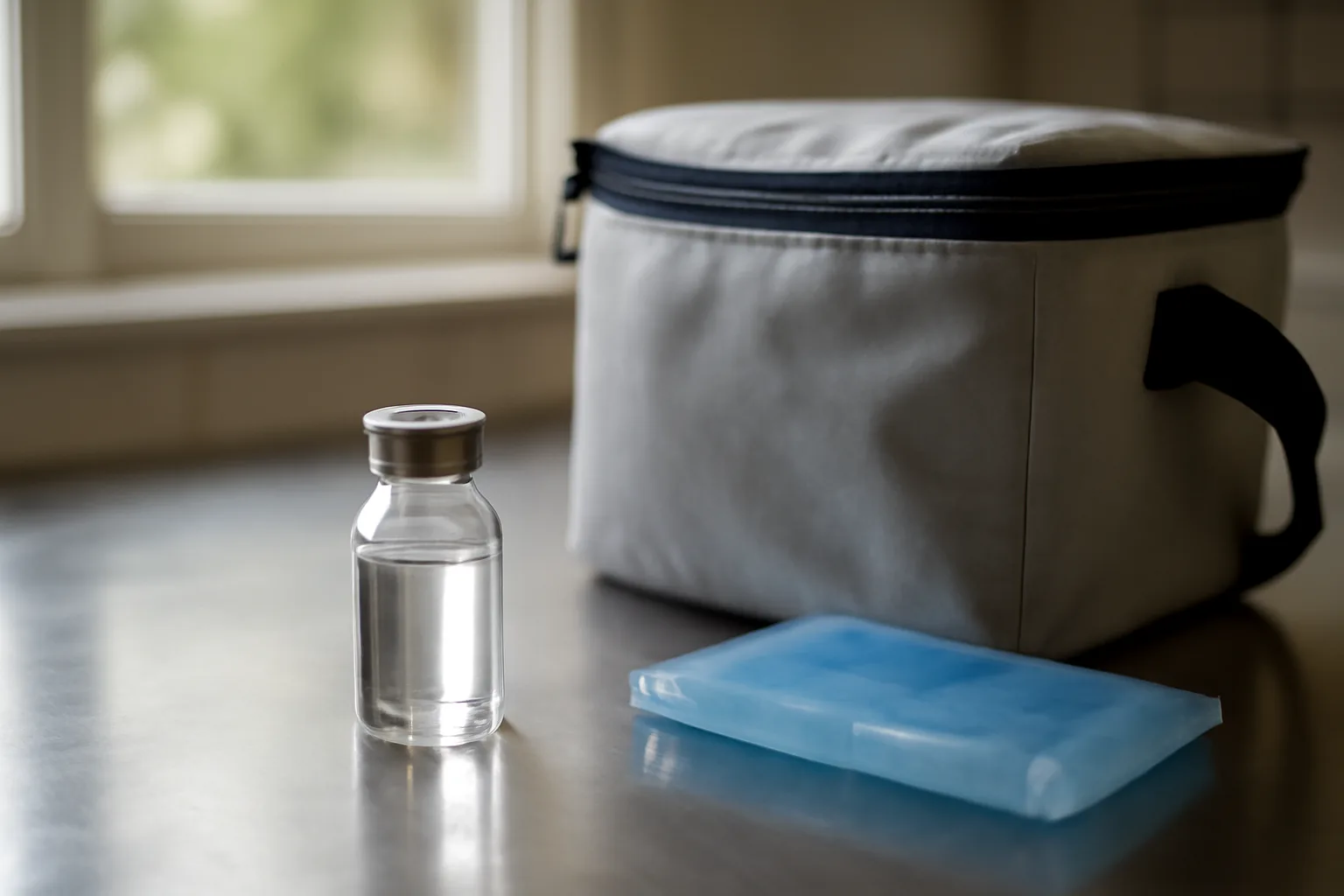
Refrigerate it. Full stop. Once bacteriostatic water is in the vial, the peptide is in solution and far more vulnerable to degradation from heat and light than the dry powder ever was. Room temperature storage after mixing shortens usable life dramatically and isn't supported by the approved product's labeling, which calls for refrigerated storage of the reconstituted solution. If a vial gets left out overnight by accident, don't guess, most practitioners' safest call is to treat that vial as compromised and not rely on it for a full course of therapy, especially given how much of the trial evidence behind tesamorelin depends on consistent nightly dosing to reproduce visceral fat reductions seen in the phase 3 program . Traveling with reconstituted tesamorelin needs a real cold chain, an insulated cooler with an ice pack, not a bag tossed in a suitcase. If you can't keep it cold in transit, don't bring the mixed vial. Bring unmixed powder and bacteriostatic water separately and mix on arrival instead.
Can tesamorelin be frozen, before or after mixing?
Unmixed lyophilized powder can often tolerate brief freezer storage, and some suppliers ship product this way. But freezing is not a substitute for reading your specific product's storage instructions, and freeze-thaw cycling (repeatedly freezing and refrigerating) is a real risk for protein and peptide degradation because ice crystal formation can physically damage the peptide structure. Once reconstituted, tesamorelin should not be frozen. The solution's stability profile after mixing is validated for refrigerated conditions, not frozen ones, and repeated freeze-thaw of a liquid peptide solution is one of the more reliable ways to destroy potency. If you've mixed more than you need, the fix isn't the freezer, it's mixing smaller batches more often, or working with your prescriber to size the vial appropriately for your dosing schedule in the first place. See tesamorelin cycle length for how typical treatment durations affect how much you actually need on hand at once.
What temperature range actually matters, and does a brief excursion ruin it?
The standard cold-chain range cited across peptide and biologic storage guidance is 2-8°C (36-46°F), refrigerator temperature, not freezer temperature. A brief excursion, say a few hours at room temperature during a lost-power event or a delivery delay, is not automatically catastrophic for lyophilized powder, but it is a bigger concern for reconstituted solution. There's no published tesamorelin-specific data telling patients exactly how many hours at what temperature causes a measurable potency drop; that kind of narrow excursion tolerance testing isn't something manufacturers typically publish for patient-facing labeling. The honest answer is: minimize excursions, don't test the limits, and treat repeated or extended warm exposure (a full day unrefrigerated, a hot car, a windowsill in summer) as a reason to discard and replace rather than gamble on a compound that costs real money and is doing a specific clinical job. For cost context on why this matters practically, unnecessary waste from storage mistakes adds up fast given typical tesamorelin pricing; see tesamorelin cost for current ranges.
How can you tell if tesamorelin has gone bad?
Visual inspection catches the obvious failures. The reconstituted solution should be clear and colorless to slightly opalescent, with no visible particles, cloudiness, or discoloration. If it looks off, discard it, no exceptions, regardless of how many days remain on your use-by window. What visual inspection can't catch is subtler potency loss, a peptide can lose meaningful bioactivity while still looking perfectly clear. This is the invisible risk with heat exposure or extended storage past the labeled window. You won't see reduced GH-releasing activity in the vial; you'll notice it, if at all, as a treatment that doesn't seem to be working, which is a frustrating and expensive way to find out. Because there's no home test for peptide potency, the practical rule is conservative: respect the labeled dates, keep it cold, and when in doubt throw it out rather than inject something you can't verify is still effective.
Does compounded tesamorelin have different storage rules than the FDA-approved drug?
Potentially, yes, and this is worth understanding before you buy. Egrifta SV went through FDA's formal approval pathway, which included specific stability studies tied to its exact formulation and packaging, and its labeling reflects that testing directly. Compounded tesamorelin is prepared under a different regulatory framework. Section 503A allows licensed pharmacies to compound using bulk substances on FDA's 503A bulks list [3][5], while larger 503B outsourcing facilities compound under separate rules using the 503B bulks list [4]. Neither pathway requires the same premarket stability trials that a branded, FDA-approved product undergoes; instead, compounders establish beyond-use dates through their own testing and USP compounding chapter standards. The FDA's own bulk drug substance nomination list [6] and its compounding guidance page [5] are the reference documents that govern what's permitted, not brand-name labeling. The practical takeaway: don't assume a compounded vial follows Egrifta SV's stated storage window. Ask the specific pharmacy that compounded it for their beyond-use date and storage instructions, and follow those exactly.
What's the difference between expiration date and beyond-use date?
An expiration date applies to an FDA-approved, manufactured drug product like Egrifta SV. It's set through formal, controlled stability studies submitted to FDA as part of the approval process, and it reflects how long the sealed, unopened product retains full potency and safety under labeled storage conditions. A beyond-use date (BUD) applies to compounded preparations. It's assigned by the compounding pharmacist based on USP compounding standards, ingredient stability data, and the specific formulation, and it is often more conservative and shorter than a manufacturer's expiration date because it isn't backed by the same scale of testing. Both dates assume specified storage conditions (typically refrigerated, 2-8°C) were maintained the entire time. Neither date is a guarantee if the product was mishandled, left warm, or frozen after reconstitution. Read the specific date and conditions printed on your vial, not a general peptide rule of thumb.
How does storage affect dosing consistency and treatment results?
The evidence base behind tesamorelin's visceral fat reduction is built entirely on trials where dosing was consistent and controlled. The pooled phase 3 analysis showed tesamorelin reduced visceral adipose tissue with maintained effects through an extension period when dosing was reliable , and separate work found tesamorelin's fat quality benefits held independent of the amount of fat lost . None of that evidence tells you what happens when the drug itself has degraded before injection, because the trials used properly stored, quality-controlled study drug. Inconsistent storage introduces a variable the trials never tested: reduced or variable potency from vial to vial. If you're injecting degraded tesamorelin, you're not really replicating the phase 3 dosing regimen anymore, you're running an uncontrolled experiment on yourself with an unknown effective dose. That matters more with tesamorelin than with some drugs because its clinical benefit (reduction in visceral fat, improvements in liver fat markers seen in the NAFLD trial ) depends on hitting a GH-axis stimulation threshold nightly, not on rough averages over time. Good storage discipline is part of good dosing discipline. See tesamorelin how to inject and tesamorelin injection sites for the rest of the administration routine that storage feeds into.
What about traveling or shipping tesamorelin, does cold-chain matter in transit?
Yes, and this is where a lot of at-home storage mistakes actually happen, not in the fridge at home but in the gap between delivery and refrigeration. Reputable pharmacy partners ship lyophilized tesamorelin with cold packs and insulated packaging specifically because the product needs to stay within a controlled temperature range from the moment it leaves the pharmacy. If a shipment arrives warm, with melted ice packs and no chill left in the box, that's a legitimate reason to contact the pharmacy before using the product, not a reason to assume it's fine because the box 'felt cool enough.' A provider-reviewed sourcing relationship, the kind Tesamorelin Co points readers toward, matters here specifically because it connects you to pharmacy partners who manage that cold chain and stand behind it, rather than an anonymous seller with no accountability for a warm box on your porch. For your own travel, whether that's a weekend trip or flying with medication, plan the same way: insulated cooler, ice pack, minimal time outside refrigeration, and mix only what you need for the trip rather than carrying a fully reconstituted vial through airport security and hours of transit heat.
Frequently asked questions
How long does tesamorelin last once reconstituted?
Egrifta SV's labeling specifies use of the reconstituted solution within a defined refrigerated window, commonly cited as up to 14 days when kept at 2-8°C. Compounded versions may differ, so check your specific pharmacy's beyond-use date rather than assuming the branded product's timeline applies.
Can I store tesamorelin at room temperature?
Unmixed powder tolerates brief room-temperature handling better than reconstituted solution does, but refrigeration (2-8°C, 36-46°F) is the labeled storage condition and the safe default for both. Reconstituted tesamorelin left at room temperature for extended periods should be considered compromised, not used.
Does tesamorelin need to be refrigerated?
Yes. Both unmixed lyophilized powder and reconstituted solution are meant to be stored refrigerated at 2-8°C (36-46°F). This is standard for peptide biologics generally and reflects the storage conditions used in tesamorelin's own stability testing and labeling.
Can tesamorelin be frozen?
Unmixed lyophilized powder can sometimes tolerate freezer storage depending on the specific product's instructions, but reconstituted solution should never be frozen. Freeze-thaw cycling risks physical damage to the peptide structure and is not part of any validated storage protocol for the mixed product.
How do I know if my tesamorelin has expired or gone bad?
Check the printed expiration date (branded product) or beyond-use date (compounded product) first. Visually, discard any reconstituted solution that looks cloudy, discolored, or contains particles. Potency loss from mild heat exposure isn't always visible, so respecting labeled dates matters even when the vial looks normal.
Is the shelf life different for compounded tesamorelin versus Egrifta SV?
Often yes. Egrifta SV's expiration date comes from FDA-reviewed stability studies specific to its formulation. Compounded tesamorelin, prepared under 21 U.S.C. 353a and FDA's 503A/503B bulk substance rules, gets a beyond-use date set by the compounding pharmacy's own testing, which can be shorter and differs by pharmacy.
What temperature is too warm for stored tesamorelin?
The recommended range is 2-8°C (36-46°F). There's no published tesamorelin-specific cutoff for exactly how many hours above that temperature causes measurable potency loss, so the conservative approach is to minimize any time spent outside refrigeration rather than test tolerance limits.
Can I still use tesamorelin if it was left out overnight?
This depends on how warm the room was and whether it's mixed or unmixed powder, but the cautious and commonly recommended approach is to treat an overnight room-temperature exposure of reconstituted solution as a reason to discard the vial rather than risk an under-dosed injection.
How should I store tesamorelin while traveling?
Use an insulated cooler with an ice pack to maintain 2-8°C the entire trip. If you can't guarantee consistent refrigeration, travel with unmixed powder and bacteriostatic water separately and reconstitute only once you've arrived somewhere with reliable fridge access.
Does bacteriostatic water storage affect tesamorelin shelf life?
The bacteriostatic water itself (with benzyl alcohol as a preservative) is what allows a multi-dose reconstituted vial to be used across several days rather than requiring single-use disposal, but the tesamorelin peptide's own stability window after mixing is still the limiting factor, not the water's shelf life alone.
Why does tesamorelin need bacteriostatic water instead of plain sterile water?
Bacteriostatic water contains a preservative (typically benzyl alcohol) that inhibits bacterial growth across multiple uses of the same vial, which is what allows the reconstituted solution to be used over its labeled window instead of requiring a fresh single-use vial for every injection.
What's the actual shelf life difference between powder and reconstituted tesamorelin?
Unmixed, refrigerated lyophilized powder is stable for the full period printed on its expiration or beyond-use date, often well over a year from manufacture. Once reconstituted, that window collapses to a much shorter refrigerated-use period specified in the product's labeling, commonly on the order of two weeks.
Sources
- PubMed, Tesamorelin (PMID 31644039): Tesamorelin is described as a synthetic GHRH analogue used in HIV-associated lipodystrophy.
- Nature Reviews Drug Discovery, Tesamorelin (PMID 21283099): Tesamorelin's identity and mechanism as a GHRH analogue drug entering the market is documented.
- 21 U.S.C. 353a, pharmacy compounding: Section 503A establishes the statutory framework under which licensed pharmacies may compound drug preparations including tesamorelin.
- 21 CFR 216.24, the 503B Bulks List: 503B outsourcing facilities compound using bulk drug substances listed under a separate regulatory bulks list from 503A pharmacies.
- FDA, bulk drug substances used in compounding under section 503A: FDA's compounding guidance page governs which bulk substances, including tesamorelin, are permitted for 503A compounding and under what conditions.
- FDA, bulk drug substances nominated for use in compounding (current list): FDA maintains a nomination list of bulk drug substances considered for compounding use, the relevant reference document for compounded tesamorelin's regulatory status.
- PubMed, Tesamorelin improves fat quality independent of changes in fat quantity (PMID 33756511): Tesamorelin's benefit on fat quality was found to occur independent of the magnitude of fat quantity reduction.
- PubMed, Population pharmacokinetic analysis of tesamorelin in HIV-infected patients and healthy subjects (PMID 25358450): Population pharmacokinetic modeling shows tesamorelin's clearance and distribution behavior is sensitive to formulation and handling factors relevant to consistent dosing.
- PubMed, Visceral fat reduction with tesamorelin is associated with improved liver enzymes in HIV (PMID 28832410): Visceral fat reduction from tesamorelin treatment was linked to improved liver enzyme markers in HIV patients.
- PubMed, Effects of tesamorelin on non-alcoholic fatty liver disease in HIV: a randomised, double-blind, multicentre trial (PMID 31611038): A randomized double-blind multicenter trial evaluated tesamorelin's effect on NAFLD in HIV patients.
- PubMed, Effects of tesamorelin (TH9507) in HIV-infected patients with excess abdominal fat: pooled analysis of two phase 3 trials with safety extension data (PMID 20554713): Pooled phase 3 trial data with safety extension showed maintained visceral adipose tissue reduction with consistent tesamorelin dosing.