Last updated 2026-07-25
TL;DR
Tesamorelin (Egrifta) is FDA-approved as a subcutaneous injection given into the abdominal fat, with sites rotated daily to avoid lumps or skin thinning. The phase 3 trials that got it approved used this same abdominal, once-daily subcutaneous protocol. Anywhere outside the approved HIV-lipodystrophy indication is off-label use, not a separate dosing route.
Where do you actually inject tesamorelin?
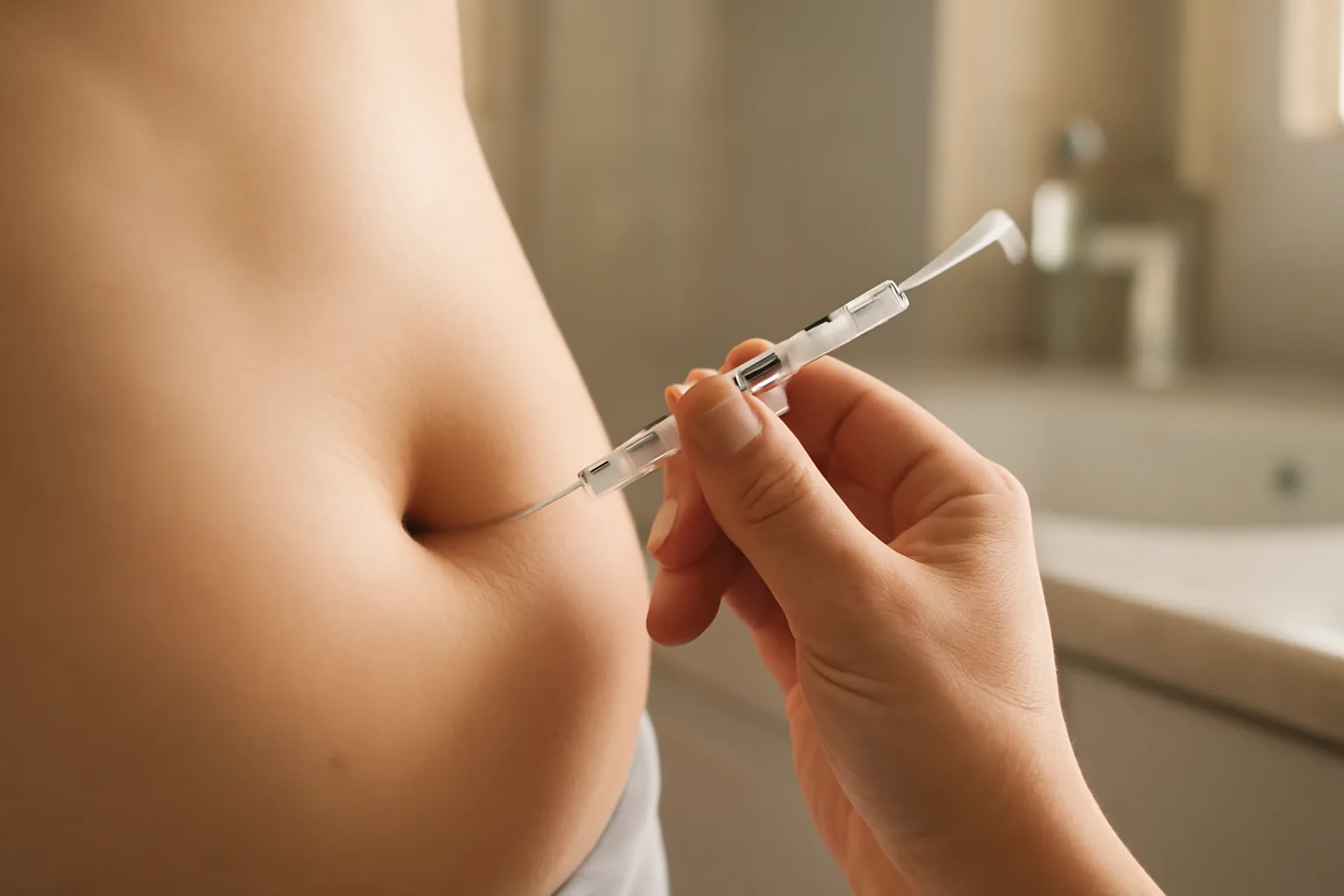
Tesamorelin, sold under the brand name Egrifta (and the newer autoinjector Egrifta SV), is given as a subcutaneous injection, meaning it goes into the fat layer just under the skin, not into muscle. The approved site is the abdomen [1][2]. That's not arbitrary. The phase 3 trials that got tesamorelin approved for HIV-associated lipodystrophy dosed it subcutaneously into the abdominal region, and the drug's pharmacokinetic profile was characterized on that basis . Within the abdomen, you have room to move around. Clinicians generally tell patients to pick a spot a couple of inches from the belly button, avoiding the area directly around the navel itself, and to rotate spots each day. This isn't unique to tesamorelin, either. It's the same basic subcutaneous injection logic used for insulin and other daily-injection peptides: spread the workload across enough tissue that no single patch gets overused. If you want the mechanics of the injection itself, needle angle, pinch technique, syringe handling, that's covered separately in tesamorelin how to inject. This section is about site selection specifically.
Why is the abdomen the approved injection site and not somewhere else?
The abdomen was the site used throughout the phase 3 program, and it happens to be the same region where tesamorelin does its main job: reducing visceral adipose tissue in HIV-associated lipodystrophy . Injecting into that tissue isn't why it works. Tesamorelin works systemically, by stimulating the pituitary to release growth hormone. The abdomen is practical for a different reason: it has enough subcutaneous fat in most patients to give a consistent, comfortable injection site, and it's easy to reach and see. The pooled phase 3 analysis of two multicenter, double-blind, placebo-controlled trials establishing tesamorelin's effect on visceral fat used this dosing approach as the basis for the safety and efficacy data submitted to FDA . That means every efficacy number you see quoted for tesamorelin (visceral fat reduction, changes in liver fat, lipid effects) comes from a trial population injecting subcutaneously into the abdomen. There isn't a parallel dataset for, say, thigh or upper-arm injection. Switching sites outside the abdomen isn't something the approved label supports, and it isn't something the trials tested.
How often should you rotate injection sites?
Daily rotation is standard practice for a drug that's dosed once a day, every day, indefinitely (or at least for as long as the treatment course runs). The basic rule: don't inject the exact same spot two days in a row. Move a few centimeters over each time, and cycle across the available abdominal area (left side, right side, upper, lower) before you come back to a spot you've already used. The reason is mechanical, not pharmacological. Repeated injections into the same small patch of skin can cause local skin reactions: redness, welts, or in rare cases lipohypertrophy (a lump of thickened fat tissue) or lipoatrophy (a dent from fat loss). Local injection site reactions were among the adverse events tracked in the phase 3 program , and rotating sites is the standard mitigation, the same advice given to insulin users for the same reason. A simple habit helps: keep a mental map, or literally draw a grid on paper, and note which quadrant you used yesterday. It sounds fussy for a two-second decision. But four weeks in, if you haven't been deliberate about it, you'll usually find you've been favoring one spot without realizing it.
What happens if you inject into muscle instead of fat?
Tesamorelin is designed for subcutaneous delivery, not intramuscular. Injecting into muscle isn't something the trials tested, and there's no published pharmacokinetic data on what an intramuscular tesamorelin injection does to absorption timing or peak levels. You're flying blind if you do it. In practice, the risk with tesamorelin is usually the opposite problem: injecting too shallow (intradermal, into the skin itself) rather than too deep, because the abdominal pinch technique is meant to lift the fat layer away from underlying muscle. If you consistently feel sharp pain rather than a dull pressure sensation, or if you're using a longer needle than needed, you might be going too deep. A correctly sized needle and a solid pinch of subcutaneous tissue keeps you in the right layer. The drug's population pharmacokinetic profile, including how it's absorbed and cleared in both HIV-infected patients and healthy subjects, was modeled based on the approved subcutaneous route . Deviating from that route means you're outside any data anyone has actually collected.
Does injection site affect how well tesamorelin works?
There's no published trial evidence comparing abdominal injection against other sites for efficacy, so nobody can honestly say whether site changes clinical outcomes. What we do know: the phase 3 program, which found real reductions in visceral adipose tissue and downstream benefits like improved liver enzymes tied to visceral fat reduction and reduced hepatic fat in a randomized NAFLD trial , ran entirely on abdominal subcutaneous dosing. One detail worth knowing: a post hoc analysis looked at whether the presence of dorsocervical fat (the so-called buffalo hump sometimes seen in HIV lipodystrophy) changed how patients responded to tesamorelin, and it did not meaningfully alter the drug's effect on visceral fat . That's a body composition variable, not an injection-site variable, but it's a useful reminder that tesamorelin's action is systemic (via growth hormone release) rather than local to wherever you inject.
Can you inject tesamorelin somewhere other than the stomach?
The approved label and the phase 3 trials used abdominal subcutaneous injection [1][2]. Using a different site (thigh, upper arm, flank) has not been studied in tesamorelin's clinical trial program, so there's no efficacy or safety data to point to if you go off-label on site selection, separate from going off-label on indication. Some patients ask about this because they've run out of comfortable real estate on the abdomen, especially if visceral fat reduction has already changed the local tissue over months of use. If that's your situation, the honest answer is: talk to the prescribing clinician rather than improvising. This is exactly the kind of question a provider-reviewed protocol exists to answer, because it depends on individual anatomy and how much abdominal tissue you actually have to work with. For the mechanical side of things, the sequence for prepping and drawing up a dose is covered in how to reconstitute tesamorelin, and timing considerations (morning versus evening dosing, relationship to meals) are in best time to take tesamorelin peptide.
What injection site reactions should you watch for?
Local injection site reactions are one of the more common tolerability issues reported across tesamorelin's trial history: redness, itching, bruising, or mild swelling at the injection site. These were tracked as adverse events in the pooled phase 3 safety data and in follow-on trials in newer HIV treatment contexts, including a study of tesamorelin's efficacy and safety in people with HIV on integrase inhibitors [3]. Most site reactions are mild and self-limited. What should prompt a call to the prescribing clinician: a hard lump that doesn't go away after a few days, spreading redness, or a site that feels warm and increasingly painful (signs that could indicate infection rather than a routine local reaction). Rotating sites, using a clean technique, and not reusing needles all reduce this risk, but they don't eliminate it entirely for every patient. Separately, tesamorelin carries systemic considerations that aren't about the injection site at all. Insulin sensitivity changes and fluid retention are the ones flagged most consistently in the label and trial literature, but those are metabolic effects of growth hormone stimulation, not something that changes based on where you inject.
Is tesamorelin FDA-approved, and does that cover general fat loss?
Yes, tesamorelin is FDA-approved, but only for a specific, narrow indication: reduction of excess abdominal fat in HIV-infected patients with lipodystrophy [1][2]. It is not approved for general fat loss, weight loss in people without HIV, bodybuilding, or anti-aging use. Any use outside that approved population and indication is off-label, meaning a clinician is prescribing it based on judgment and the broader evidence base, not because FDA has reviewed and approved that use. The drug is a synthetic analogue of growth hormone-releasing hormone (GHRH) [4], meaning it stimulates the pituitary gland to release the body's own growth hormone, rather than supplying growth hormone directly. That mechanism is well described in the drug discovery literature [4] and in reviews covering its development history . The evidence base behind the approval is real and reasonably deep for the approved population: multiple randomized, placebo-controlled phase 3 trials , a meta-analysis of randomized controlled trials on body composition and hepatic fat outcomes , and mechanistic work on fat quality changes [5] and hepatic transcriptomic signatures in HIV-associated NAFLD [6]. None of that evidence extends automatically to a person without HIV using tesamorelin for cosmetic fat reduction; extrapolating trial results from an HIV-lipodystrophy population to a general population is exactly the kind of leap the data doesn't support.
How does the approved dose and injection schedule work?
Tesamorelin is dosed once daily as a subcutaneous injection [1][2]. The trials establishing efficacy for visceral fat reduction ran on a daily injection schedule sustained over months, not a one-off or occasional dosing pattern. This matters for injection site planning: a once-daily regimen over a 6-to-12-month treatment course (or longer, in extension studies) means dozens to hundreds of injections, which is exactly why site rotation across the abdomen is emphasized rather than optional. For the specific numbers behind dosing amounts, reconstitution ratios, and how long a typical course runs, see tesamorelin cycle length and tesamorelin half life, which cover the pharmacokinetics in more depth . This section is focused on the physical logistics of where the needle goes, not the milligram amounts.
What does a typical injection site rotation schedule look like?
| Day 1 | Upper right abdomen | |
|---|---|---|
| Day 2 | Upper left abdomen | |
| Day 3 | Lower right abdomen | |
| Day 4 | Lower left abdomen | |
| Day 5 | Back to upper right, shifted 2-3 cm from Day 1 spot | This is a practical convention, not a trial protocol. The phase 3 studies didn't publish a specific rotation grid; they simply used subcutaneous abdominal injection as the delivery method . The point of any rotation scheme is the same: never hit the identical point twice in a row, and give each patch of skin at least several days to recover before it's used again. |
There's no single FDA-mandated rotation map, but a practical, commonly used approach divides the abdomen into four quadrants around the navel (avoiding the area immediately at the navel itself) and cycles through them in sequence. | Day | Suggested zone |
Where does provider-reviewed sourcing fit into injection site decisions?
Injection site technique is something a prescribing clinician should walk you through directly, because it depends on your abdominal fat distribution, any scarring or prior surgery in that region, and how the treatment course is progressing. Tesamorelin Co works with a provider-reviewed pathway that connects patients to a licensed prescriber and a named fulfilling pharmacy partner, rather than shipping product with no clinical oversight attached. That matters more for tesamorelin than for a lot of peptides, precisely because it is an FDA-approved drug with a real label and real trial data behind the approved use [1][2]. Buying from a source with no prescriber involved means nobody is checking that your indication, dose, and injection technique actually match what the evidence supports, and nobody is available to answer the kind of judgment-call question ('can I move to my thigh, I've run out of room') that comes up in month four of a treatment course.
What if you're using tesamorelin off-label, does the injection advice still apply?
The mechanics don't change: subcutaneous injection into abdominal fat, rotated daily, is the delivery method regardless of why someone is using the drug. What changes off-label is the evidence backing the outcome you're hoping for. The phase 3 trials, the meta-analysis of randomized controlled trials , and the mechanistic studies on hepatic fat [6] and inflammatory markers were all done in HIV patients with lipodystrophy and excess abdominal fat. A separate line of literature has started looking at peptide therapies, including GHRH analogues like tesamorelin, in sports medicine and musculoskeletal contexts [7][8]. That work is preliminary and explicitly framed around safety and efficacy questions still being worked out, not established off-label protocols. If you're using tesamorelin for something other than its approved indication, the injection-site guidance in this article still applies mechanically, but you should not assume the visceral fat, liver, or metabolic outcomes from the HIV trials will transfer to your situation.
Frequently asked questions
Where exactly on the abdomen should tesamorelin be injected?
A few inches away from the navel, avoiding the area directly around it. Pick a spot with a comfortable pinch of subcutaneous fat, and move to a different spot each day rather than reusing the same point repeatedly.
Can tesamorelin be injected into the thigh or arm instead of the stomach?
The approved label and the phase 3 trials used abdominal subcutaneous injection [3][4][24]. There's no published trial data on other sites, so switching away from the abdomen isn't supported by the evidence base; check with the prescribing clinician first.
How often do you need to rotate tesamorelin injection sites?
Daily. Since tesamorelin is dosed once a day for months at a time [24], never injecting the same exact spot on consecutive days is standard practice, the same logic used for daily insulin injections, to avoid lumps or skin thinning.
What are the most common injection site reactions with tesamorelin?
Redness, itching, bruising, and mild swelling are the reactions most often reported in tesamorelin's phase 3 and follow-on trials [5][24]. Most are mild and resolve on their own; a persistent hard lump or spreading redness warrants a call to the prescriber.
Is tesamorelin injected into muscle or fat?
Fat. Tesamorelin is a subcutaneous injection, meaning it goes into the fat layer under the skin, not into muscle [3][4]. Intramuscular injection hasn't been studied for this drug and isn't part of the approved delivery method.
Does where you inject tesamorelin change how well it works?
No trial has directly compared injection sites for efficacy. All of tesamorelin's phase 3 evidence for visceral fat reduction comes from abdominal subcutaneous dosing [24], so that's the only site with data behind it.
Is tesamorelin FDA-approved for fat loss in general?
No. Tesamorelin is FDA-approved specifically for reducing excess abdominal fat in HIV-infected patients with lipodystrophy [3][4]. Use for general weight loss, cosmetic fat reduction, or anti-aging in people without that diagnosis is off-label.
What needle size is used for tesamorelin injections?
Tesamorelin uses standard subcutaneous injection needles similar to those used for insulin, short and fine-gauge, designed to reach the fat layer without going into muscle. Specific needle handling and pinch technique are covered in the dosing guides on injection mechanics.
Can dorsocervical fat (buffalo hump) affect tesamorelin injection or results?
A post hoc analysis of a phase 3 trial found that the presence of dorsocervical fat didn't meaningfully change tesamorelin's effect on visceral adipose tissue [23]. This is a body composition factor, not an injection site issue; the abdomen remains the injection site regardless.
How long is a typical tesamorelin injection course?
Phase 3 trials and extension studies ran tesamorelin dosing over roughly 6 to 12 months and beyond, as a once-daily subcutaneous injection [24]. Exact course length is a clinical decision; see the dedicated cycle-length guide for specifics.
What happens if you inject tesamorelin too shallow or too deep?
Too shallow (intradermal) can cause more irritation at the skin surface; too deep risks reaching muscle, which hasn't been studied for this drug. A proper pinch of subcutaneous tissue and correct needle angle keeps the injection in the intended fat layer.
Do you need a prescription and provider oversight for tesamorelin injections?
Yes. Tesamorelin is a prescription-only FDA-approved drug [3][4]. A provider-reviewed pathway with a licensed prescriber and a named fulfilling pharmacy is the appropriate route, rather than sourcing it with no clinical oversight attached.
Sources
- PubMed, Therapeutic Peptides in Orthopaedics (PMID 41490200): Peptide therapies including GHRH analogues are being studied in orthopaedic and musculoskeletal contexts as an emerging, not yet established, area.
- PubMed, Tesamorelin, Nature Reviews Drug Discovery (PMID 21283099): Tesamorelin is a synthetic analogue of growth hormone-releasing hormone (GHRH) that stimulates pituitary growth hormone release.
- FDA, Drugs@FDA database: Tesamorelin (Egrifta) is an FDA-approved prescription drug, searchable in the FDA's approved drug products database.
- PubMed, Tesamorelin review (PMID 31644039): Tesamorelin is approved for reduction of excess abdominal fat in HIV-infected patients with lipodystrophy, administered by subcutaneous injection.
- PubMed, Efficacy and safety of tesamorelin in people with HIV on integrase inhibitors (PMID 38905488): A study assessed tesamorelin's efficacy and safety, including tolerability, in people with HIV on integrase inhibitor regimens.
- PubMed, Injectable Peptide Therapy primer (PMID 41476424): A primer for orthopaedic and sports medicine physicians reviews injectable peptide therapies including safety considerations.
- PubMed, Hepatic transcriptomic signatures in HIV-associated NAFLD (PMID 32701508): Tesamorelin altered hepatic transcriptomic signatures associated with HIV-associated NAFLD in trial participants.
- PubMed, Tesamorelin improves fat quality (PMID 33756511): Tesamorelin improved fat quality independent of changes in fat quantity in study participants.
- PubMed, Body composition, hepatic fat, metabolic outcomes meta-analysis (PMID 41545261): A meta-analysis of randomized controlled trials evaluated tesamorelin's effects on body composition, hepatic fat, and metabolic and safety outcomes in HIV-associated lipodystrophy.
- PubMed, Population pharmacokinetic analysis of tesamorelin (PMID 25358450): Tesamorelin's pharmacokinetic profile was characterized via population analysis in HIV-infected patients and healthy subjects using the subcutaneous route.
- PubMed, Visceral fat reduction and liver enzymes (PMID 28832410): Visceral fat reduction with tesamorelin was associated with improved liver enzymes in people with HIV.
- PubMed, Tesamorelin and NAFLD randomized trial (PMID 31611038): A randomized, double-blind, multicenter trial found tesamorelin reduced hepatic fat in people with HIV and NAFLD.
- PubMed, Post hoc analysis of dorsocervical fat (PMID 36845310): A post hoc analysis of a phase 3 trial found tesamorelin's effect on visceral fat was not meaningfully altered by the presence of dorsocervical fat.
- PubMed, Pooled phase 3 analysis of tesamorelin trials (PMID 20554713): A pooled analysis of two multicenter, double-blind, placebo-controlled phase 3 trials with safety extension data established tesamorelin's efficacy and safety in HIV patients with excess abdominal fat via subcutaneous dosing.
- PubMed, Tesamorelin and inflammatory markers (PMID 21516030): Tesamorelin's effects on inflammatory markers in HIV patients with excess abdominal fat were linked to visceral adipose tissue reduction.
- PubMed, Tesamorelin, human GHRH analogue (PMID 19243281): Tesamorelin's development history as a human growth hormone releasing factor analogue is reviewed in early investigational drug literature.