Last updated 2026-07-25
TL;DR
tesamorelin is an fda-approved lyophilized peptide (brand name egrifta) that has to be reconstituted with sterile water for injection before use. mix gently (never shake), use it within the manufacturer's stated window once mixed, and keep it refrigerated. this is a mechanical, sterile-technique problem, not a dosing one; get that part separately right first.
what does it mean to reconstitute tesamorelin
tesamorelin, the growth hormone-releasing hormone (GHRH) analogue sold as Egrifta (and its longer-acting formulation Egrifta SV), doesn't come ready to inject. It ships as a freeze-dried powder in a glass vial because peptides are not stable in liquid form for long periods. Reconstitution just means adding a sterile liquid, almost always bacteriostatic water or sterile water for injection, to turn that powder back into a solution you can draw into a syringe. This is standard for peptide drugs generally, not a tesamorelin quirk. The clinical and pharmacology literature on tesamorelin, going back to the original phase 3 program, describes it as a synthetic analogue of human GHRH that requires this kind of handling before subcutaneous injection [1]. Get the reconstitution step wrong and you either waste the vial, introduce contamination risk, or end up dosing inconsistently, none of which have anything to do with whether tesamorelin itself works. If you're still deciding whether tesamorelin is right for you at all, that's a different question than this article answers. This one assumes you (or your prescriber) have already settled on tesamorelin and now you're holding a vial of powder wondering what to do with it.
what do you need before you start
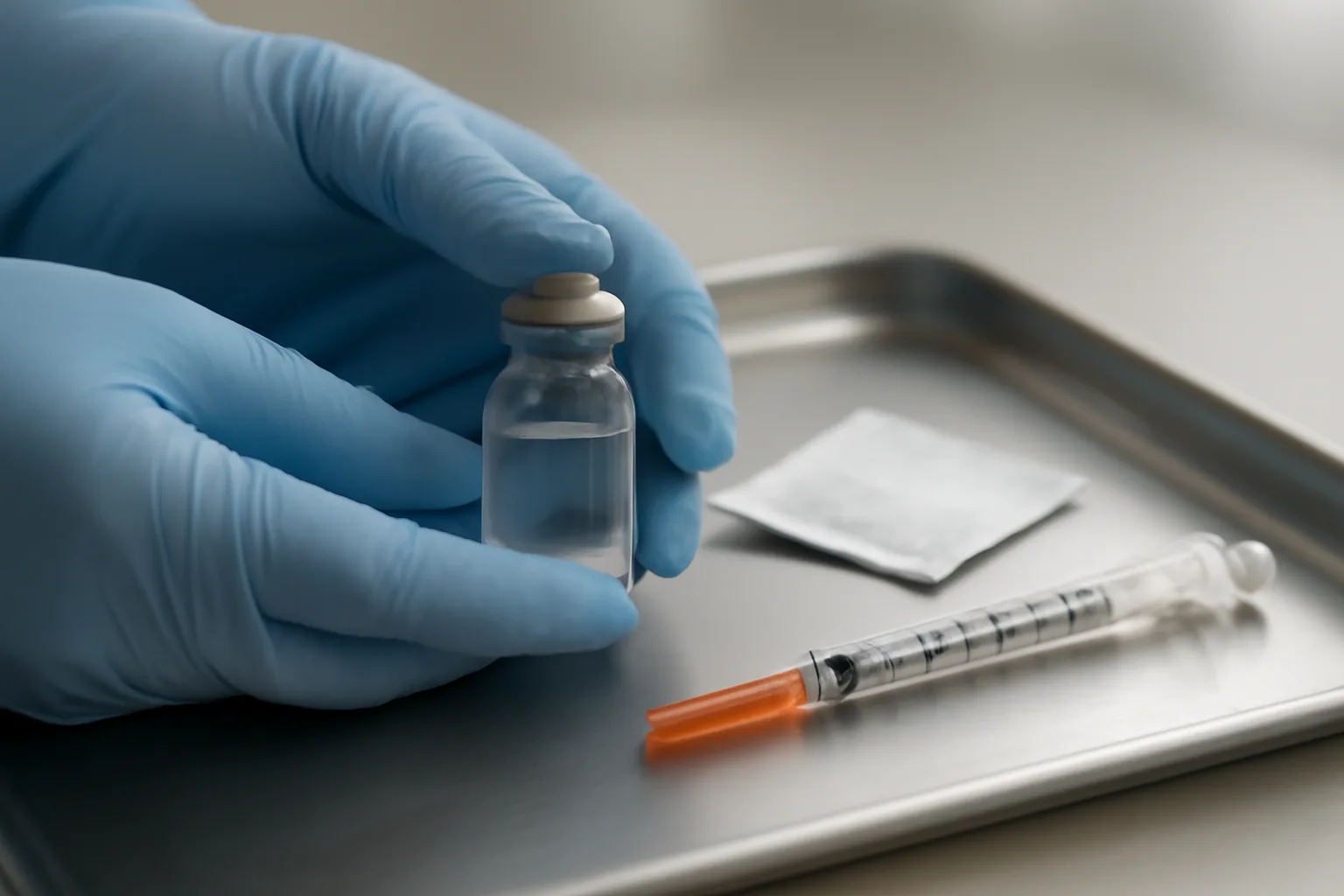
Lay everything out before you touch the vial. You want: the tesamorelin vial itself, bacteriostatic water (or sterile water, per your prescriber's instruction), alcohol swabs, a reconstitution syringe (usually a 3 mL syringe with a drawing needle) and your dosing insulin syringe (typically a 0.5 mL or 1 mL, 29-31 gauge insulin syringe for the actual injection), and a sharps container. Wash your hands first. Wipe the rubber stoppers on both the water vial and the tesamorelin vial with an alcohol swab and let them air dry for a few seconds. Don't blow on them, don't wipe and immediately jab the needle in while it's wet. This is basic sterile technique, and it matters more with a drug you're going to inject daily for months, since Egrifta's approved regimen is a once-daily subcutaneous injection [1] [2]. One thing worth deciding in advance: how much water you're adding determines your final concentration, which determines how many units you draw for your target dose. Sort that math out on paper before you start reconstituting, not after.
how much bacteriostatic water do you add to tesamorelin
There's no single universal answer here because it depends on the vial size you have and the dose you're targeting; always follow your prescriber's or pharmacy's specific reconstitution instructions for the product you were dispensed, since compounded and brand product vial strengths differ. As a general principle: the amount of water added is chosen so that the resulting concentration (mg per mL) lets you draw a practical, accurate volume on an insulin syringe for your prescribed dose. Adding too little water gives you a very concentrated, hard-to-measure-accurately solution; adding too much dilutes it so far that your target dose is a large, uncomfortable injection volume. The phase 3 trials that supported tesamorelin's approval studied a 2 mg daily subcutaneous dose in adults with HIV-associated lipodystrophy . Whatever vial and water volume you're working with, the goal of reconstitution math is simply to land on a concentration where your prescribed dose corresponds to a clean, easy-to-read syringe mark. If you're unsure of the math, call the pharmacy that dispensed it before you inject anything. Don't guess.
step by step: how to reconstitute tesamorelin
Once you have your supplies and know your target volume, the process itself is short. 1. Wipe both vial stoppers with alcohol and let dry. 2. Draw the specified amount of bacteriostatic water into your reconstitution syringe. 3. Insert the needle into the tesamorelin vial at an angle, resting the needle tip against the inside glass wall, not pointed directly at the powder. 4. Inject the water slowly, letting it run down the glass wall so it meets the powder gently rather than blasting it. 5. Remove the needle. Do not shake the vial. 6. Gently swirl or roll the vial between your palms until the powder fully dissolves. This can take anywhere from a few seconds to a couple of minutes depending on concentration. 7. Check the solution. It should be clear and colorless to pale yellow, with no visible particles or cloudiness. If it looks off, don't use it. The reason you never shake a reconstituted peptide vial is mechanical, not superstitious: vigorous agitation can denature the peptide structure by disrupting the folding and bonding that gives it biological activity. Gentle rolling dissolves the powder just as effectively without that risk. This is a general principle across therapeutic peptides, and it's one of the practical handling issues that peptide-focused clinical reviews for musculoskeletal and sports medicine use flag when discussing injectable peptide therapy broadly [3].
how long does reconstituted tesamorelin last, and how should you store it
Once mixed, reconstituted tesamorelin needs refrigeration and has a limited use window, not indefinite shelf life. Store the vial at 2-8°C (36-46°F) between uses, keep it away from light, and don't freeze it. Follow the specific expiration window given by the manufacturer's product labeling or your dispensing pharmacy for the exact product and diluent you're using, since this can vary between the brand product and compounded versions. A practical habit: write the reconstitution date directly on the vial with a permanent marker the moment you mix it. It's easy to lose track after a couple of weeks of daily injections, and guessing is a bad idea with an injectable drug. Before every single injection, more than the first, look at the vial. Cloudiness, discoloration, or visible particles after a period of correct refrigerated storage means the vial should be discarded, not used. This applies for the entire duration you're drawing from that vial, which for a once-daily regimen could be several weeks.
why can't you just shake the vial to mix it faster
Shaking feels like the natural way to dissolve a powder, but with peptides it risks damaging the very molecule you're trying to preserve. Tesamorelin, like other peptide drugs, is a chain of amino acids held together and folded in a specific three-dimensional shape; that shape is what lets it bind to the GHRH receptor and stimulate the pituitary to release growth hormone [1] [4]. Aggressive shaking introduces air bubbles and mechanical shear force into the solution, both of which can denature that structure. A denatured peptide doesn't necessarily become dangerous, but it can become inactive, meaning you're injecting a dose that no longer does what it's supposed to do. You'd have no way to know just by looking at it, since the visual cues (cloudiness, particles) that flag other reconstitution problems don't reliably show up from over-agitation alone. Gentle rolling or swirling gets the same result, full dissolution, without that risk. It just takes a little longer. That's a trade worth making every time.
how do you know if your reconstituted tesamorelin has gone bad
Check for three things before every injection: clarity, color, and particles. Properly reconstituted and stored tesamorelin solution should stay clear to very slightly pale yellow throughout its usable window. Any cloudiness, a color shift toward deeper yellow or brown, or visible floating particles or clumps means the vial is compromised and should not be used, even if it's still within the theoretical days-since-mixing window. Other red flags: if the vial was left out of the refrigerator for an extended stretch (say, an afternoon in a hot car), if it was ever frozen, or if you're not fully sure the water used was appropriately sterile, don't use it. The cost of tossing a partially used vial is real but small compared to the cost of injecting something that's degraded or contaminated. If you're weighing that cost, it helps to know the ballpark price you're working with; see our breakdown of tesamorelin cost for what a typical course runs. When in doubt, the safest move is to call the pharmacy or prescriber that provided the vial and describe exactly what you're seeing. Don't try to self-diagnose a peptide vial the way you might smell-test milk.
what's the difference between reconstituting brand egrifta and a compounded version
Egrifta and Egrifta SV are the FDA-approved brand versions of tesamorelin, manufactured under an approved New Drug Application and dispensed with manufacturer packaging, inserts, and specific reconstitution instructions tied to that exact formulation [2] . Compounded tesamorelin, by contrast, is prepared by a compounding pharmacy under separate legal authority, either a 503A pharmacy compounding for an individual patient prescription or a 503B outsourcing facility producing in larger batches; compounding uses bulk drug substances that FDA tracks on specific lists under 21 CFR 216.23 and 216.24 [5] [6], and the underlying compounding authority itself comes from 21 U.S.C. 353a [7]. The practical reconstitution difference is that a compounded vial's water volume, expected concentration, and stability window are set by that specific compounding pharmacy, not by an FDA-approved package insert. That means the numbers (how much water, how long it lasts refrigerated) can genuinely differ from the brand product, and you should follow whatever instructions came with your specific vial rather than assuming brand instructions apply. This isn't a comment on whether compounded tesamorelin works as well as the brand drug; it's simply a reminder that reconstitution protocols are vial-specific, and mixing up instructions between a compounded product and Egrifta's labeling is a common, avoidable mistake.
what syringe and needle should you use for tesamorelin
For the reconstitution step itself, a standard 3 mL Luer-lock syringe with a drawing needle (often an 18-21 gauge) works well for pulling the bacteriostatic water and injecting it into the powder vial. That needle is too thick and too long for the actual subcutaneous injection, though. For the injection itself, most patients use an insulin syringe, typically 0.5 mL or 1 mL, with a fine 29-31 gauge needle. These are calibrated in units (usually up to 50 or 100 units per syringe) rather than milliliters, which is exactly why getting your reconstitution concentration right matters: it determines how many units on that small syringe correspond to your prescribed milligram dose. For the mechanics of the injection itself, where to inject, angle, rotation of sites, see our guides on tesamorelin how to inject and tesamorelin injection sites. Reconstitution and injection technique are two separate skills, and it's worth being solid on both before you start a daily regimen.
what happens if you make a reconstitution mistake
The two most common mistakes are adding the wrong amount of water and shaking instead of rolling the vial. Adding too much or too little water changes your actual concentration versus what you assumed, which means every dose you draw afterward is off from what you or your prescriber intended, even though your syringe reading looks correct. This is a silent error: nothing about the vial looks wrong, but the math underneath it is. Shaking, discussed above, risks denaturing the peptide, which typically doesn't make the injection harmful so much as pointless, since an inactive peptide doesn't do the job it's meant to do. You wouldn't necessarily feel or see a difference; you'd just potentially get less benefit than expected over your course. If you realize partway through a vial that you mixed it with the wrong water volume, the safest move is to discard that vial and start over with a fresh one, rather than trying to correct the math mid-course. It's a wasted vial, which stings, but it's cheaper than weeks of inconsistent dosing.
does reconstitution timing affect when you should inject tesamorelin
Reconstitution and injection timing are related but separate decisions. Once a vial is properly mixed and stored, you inject at whatever time of day fits your regimen; the phase 3 trial protocol for tesamorelin used once-daily subcutaneous dosing [2] , and many patients coordinate that daily timing around bedtime to roughly mirror the body's natural nighttime growth hormone pulse, though this is a practical convention rather than a strict requirement in the approved labeling. What reconstitution timing does affect is how many days you have left to use a given vial before its stability window closes. If you mix a vial today, the clock on its usable life starts today, refrigerated, regardless of what time of day you happen to inject. For more on picking and sticking to a daily injection time, see best time to take tesamorelin peptide. And if you're mapping out how many vials you'll need across a full course, tesamorelin cycle length walks through typical trial durations and what a realistic course looks like.
what is tesamorelin actually approved for, and does that matter for how you use it
Tesamorelin (Egrifta, Egrifta SV) is FDA-approved specifically for the reduction of excess abdominal visceral fat in adults with HIV-associated lipodystrophy. That's the narrow, specific indication that phase 3 trial data supports. Pooled analysis of two multicenter, double-blind, placebo-controlled phase 3 trials found tesamorelin 2 mg daily reduced visceral adipose tissue compared to placebo, with the pooled safety extension data described in the original registration studies . Beyond visceral fat reduction, trial data in this same HIV lipodystrophy population has shown other downstream effects: reductions in visceral fat correlated with improved liver enzymes , a randomized double-blind multicenter trial found effects on non-alcoholic fatty liver disease markers , and separate work looked at hepatic transcriptomic signatures in HIV-associated NAFLD [11, referring to source 32701508] as well as proteomic and transcriptomic response pathways [8]. A 2021 study also found tesamorelin improved fat quality independent of changes in fat quantity [9]. More recent work has examined effects in people with HIV specifically on integrase inhibitor regimens [10] and looked at neurocognitive outcomes in HIV patients with abdominal obesity [11]. All of that evidence sits within the HIV-associated lipodystrophy population that the drug was studied and approved for. Using tesamorelin for general fat loss, bodybuilding, or anti-aging purposes is off-label, meaning outside what the FDA-approved labeling covers and outside the specific population the phase 3 trials enrolled. That doesn't automatically mean it can't have effects in other populations, but it does mean the strong trial evidence you're reading about doesn't directly transfer, and off-label use should happen under a prescriber's judgment, not as a DIY assumption based on lipodystrophy data.
is tesamorelin safe when reconstituted and used correctly
The phase 3 program and subsequent studies give a reasonably clear safety picture within the approved population and dose. Injection site reactions (redness, itching, mild pain) are the most commonly reported issue, consistent with any daily subcutaneous injection regimen. A meta-analysis of randomized controlled trials looking at body composition, hepatic fat, metabolic, and safety outcomes of tesamorelin in HIV-associated lipodystrophy summarized safety findings across the pooled trial evidence [12]. Other studied effects include changes in inflammatory markers, where one trial found a relationship between visceral fat reduction and inflammatory marker changes in HIV patients with excess abdominal fat . Population pharmacokinetic modeling has also been done in both HIV-infected patients and healthy subjects to characterize how the drug behaves across different patient groups . None of that safety data addresses reconstitution technique directly, since reconstitution mistakes (bad water, shaking, contamination, wrong concentration) are handling errors rather than drug effects. Good technique, sterile supplies, correct water volume, gentle mixing, proper refrigerated storage, is what keeps the safety profile studied in trials relevant to what you're actually injecting at home.
getting it right: sourcing and provider guidance
where should you actually get tesamorelin and reconstitution instructions from
The instructions in this article are general education, not a substitute for the specific reconstitution protocol that comes with your vial. Brand Egrifta ships with manufacturer package inserts; compounded tesamorelin comes with instructions set by the dispensing pharmacy, which can differ in water volume and stability window from the brand product [5] [6] [7]. The safest path is provider-reviewed: get tesamorelin through a prescriber who evaluates whether it's appropriate for you, and a pharmacy that gives you clear, product-specific mixing and storage instructions rather than generic internet advice. Tesamorelin Co works with a provider-reviewed process that connects patients to prescribers and a fulfilling pharmacy partner, so the vial you receive comes with instructions matched to that exact product, rather than you reverse-engineering concentration math from a forum post. Whatever route you take, don't skip the step of confirming your specific vial's water volume, expected concentration, and expiration window with whoever dispensed it before your first injection.
Frequently asked questions
how much bacteriostatic water do i add to reconstitute tesamorelin
It depends on your vial's mg strength and your target dose concentration; there's no single universal number. Follow the specific instructions from your prescriber or dispensing pharmacy for the exact product you have, since brand Egrifta and compounded versions can differ. If you're unsure, call the pharmacy before mixing anything.
can i shake the tesamorelin vial to help it dissolve faster
No. Shaking introduces mechanical stress and air that can denature the peptide's structure, potentially making it less active without any visible change. Roll or gently swirl the vial between your palms instead. It takes a bit longer but protects the molecule's integrity.
how long does reconstituted tesamorelin last in the fridge
Reconstituted tesamorelin should be refrigerated at 2-8°C and used within the window specified on your product's labeling or by your dispensing pharmacy, since this varies between brand Egrifta and compounded formulations. Write the mix date on the vial so you're not guessing later, and never freeze it.
what water should i use to reconstitute tesamorelin
Use bacteriostatic water or sterile water for injection, whichever your prescriber or pharmacy specifies for your product. Don't substitute tap water, distilled water from a store, or any non-pharmaceutical-grade water. The specific diluent affects both sterility and the drug's stability during storage.
how do i know if my tesamorelin vial has gone bad
Check clarity, color, and particles before every injection. It should look clear to pale yellow with nothing floating in it. Cloudiness, a darker color, visible clumps, or a vial that's been left unrefrigerated or frozen at any point should be discarded rather than used, even if it's technically within the expected time window.
what syringe do i use to inject tesamorelin after reconstituting it
Use a larger syringe (often 3 mL) with a drawing needle for mixing the powder and water, then switch to a small insulin syringe, typically 0.5 or 1 mL with a 29-31 gauge needle, for the actual subcutaneous injection. The insulin syringe's fine unit markings are what let you draw an accurate small dose.
is compounded tesamorelin reconstituted the same way as brand egrifta
Not necessarily. Compounded tesamorelin is prepared under separate legal authority from FDA-approved Egrifta, using bulk substances tracked on FDA's compounding lists, and the compounding pharmacy sets its own water volume and stability window for its specific product. Always follow the instructions that came with your specific vial rather than assuming brand instructions apply.
can i reuse a tesamorelin vial for multiple daily injections
Yes, that's the normal use pattern for a once-daily subcutaneous regimen; one reconstituted vial is drawn from repeatedly until its usable window ends or the powder runs out, whichever comes first. Keep it refrigerated between uses and inspect it visually before every single draw, more than the first.
what happens if i accidentally inject air into the tesamorelin vial
A small amount of air introduced while drawing water or medication is common and generally not dangerous for a subcutaneous vial injection; just avoid vigorously shaking the vial afterward to try to clear it, since that risks the peptide-denaturing problem discussed above. Gently tap or let it settle instead.
does tesamorelin need to be reconstituted before every injection or just once per vial
Just once per vial. You mix the whole vial with its specified water volume a single time, then draw individual doses from that same reconstituted vial across multiple days until it's used up or its stability window ends, keeping it refrigerated between draws.
is tesamorelin fda-approved for general fat loss or only for a specific condition
Tesamorelin (Egrifta, Egrifta SV) is FDA-approved specifically for reducing excess visceral abdominal fat in adults with HIV-associated lipodystrophy, based on phase 3 trial data in that population. Use for general fat loss, bodybuilding, or anti-aging is off-label and outside the population the approval evidence covers.
can i travel with reconstituted tesamorelin
Yes, but it needs to stay refrigerated or in a cold, insulated container with ice packs, since it isn't shelf-stable once mixed. Avoid leaving it in a hot car, checked luggage in cargo holds, or anywhere temperature isn't controlled, and check it for cloudiness or particles before injecting after any travel.
Sources
- PubMed, Nature Reviews Drug Discovery (2011): Tesamorelin is described as a synthetic analogue of human GHRH used therapeutically, requiring reconstitution before injection.
- PubMed, American Journal of Sports Medicine (2026): Injectable peptide therapy primer discussing practical handling considerations for peptide reconstitution and administration.
- PubMed, AIDS (2024): Study on efficacy and safety of tesamorelin in people with HIV on integrase inhibitor regimens.
- PubMed, Drugs (2011): Review of tesamorelin's structure and use in HIV-associated lipodystrophy management.
- PubMed, Journal of Infectious Diseases (2025): Study of tesamorelin effects on neurocognitive impairment in persons with HIV and abdominal obesity.
- PubMed, The Annals of Pharmacotherapy (2012): Describes tesamorelin as a once-daily subcutaneous GHRH analogue injection for HIV-associated lipodystrophy.
- eCFR, 21 CFR 216.23 (503A Bulks List): Federal regulation establishing the list of bulk drug substances that can be used in 503A pharmacy compounding.
- eCFR, 21 CFR 216.24 (503B Bulks List): Federal regulation establishing the list of bulk drug substances usable in 503B outsourcing facility compounding.
- Cornell Law School, 21 U.S.C. 353a: Statutory basis for pharmacy compounding authority under federal law.
- PubMed, AIDS (2021): Study found tesamorelin improves fat quality independent of changes in fat quantity.
- PubMed, Obesity Research & Clinical Practice (2026): Meta-analysis of randomized controlled trials summarizing body composition, hepatic fat, metabolic, and safety outcomes of tesamorelin.
- PubMed, Scientific Reports (2021): Study delineating tesamorelin response pathways in HIV-associated NAFLD using proteomic and transcriptomic approaches.
- PubMed, Clinical Pharmacokinetics (2015): Population pharmacokinetic analysis of tesamorelin in HIV-infected patients and healthy subjects.
- PubMed, AIDS (2017): Study found visceral fat reduction with tesamorelin was associated with improved liver enzymes in HIV.
- PubMed, The Lancet HIV (2019): Randomized double-blind multicenter trial of tesamorelin effects on non-alcoholic fatty liver disease in HIV.
- PubMed, Journal of Clinical Endocrinology and Metabolism (2010): Pooled analysis of two phase 3 double-blind placebo-controlled trials establishing the 2 mg daily subcutaneous tesamorelin dose and its effects on visceral fat, with safety extension data.
- PubMed, AIDS (2011): Study on effects of tesamorelin on inflammatory markers in HIV patients with excess abdominal fat and their relationship to visceral fat reduction.