Last updated 2026-07-25
TL;DR
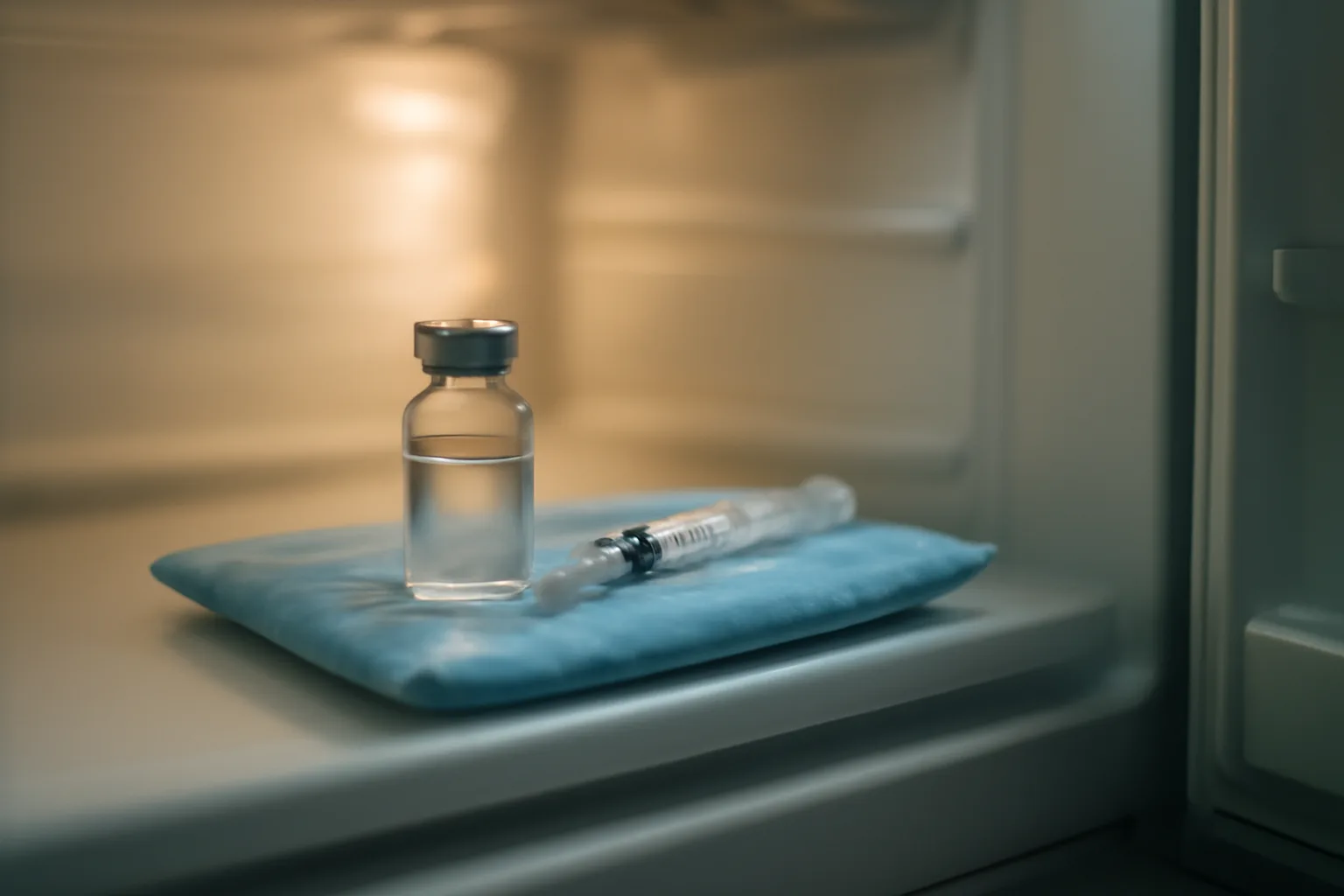
Yes. Reconstituted tesamorelin must be refrigerated at 2-8°C (36-46°F) and protected from light. Unopened lyophilized powder is stable at room temperature until mixed, but once reconstituted it degrades faster and manufacturer guidance for FDA-approved Egrifta caps use at roughly 14 days refrigerated (some formulations allow longer). Don't freeze it, don't leave it on a counter, and don't inject a solution that's cloudy or discolored.
Does tesamorelin need to be refrigerated after mixing?
Yes. Once tesamorelin powder is reconstituted with water (or the diluent that ships with it), it becomes a peptide solution in an aqueous environment, and peptides in solution degrade faster than dry lyophilized powder. The degradation happens through hydrolysis, oxidation, and aggregation, all of which speed up at room temperature and speed up further in heat or light. Refrigeration at 2-8°C (36-46°F) slows those reactions enough to keep the peptide usable for the labeled window. This isn't unique to tesamorelin. It's true of essentially every reconstituted peptide, from GLP-1 drugs to growth hormone itself. The FDA-approved product, sold as Egrifta (and the ready-to-mix pen version Egrifta SV), is labeled with specific storage instructions because the sponsor generated real stability data to support those instructions during the drug approval process [1] [2]. That's a meaningfully different situation from an unapproved compounded or research-grade tesamorelin product, where nobody has published a stability study specific to that manufacturer's formulation, buffer, or vial. The bottom line: don't treat reconstituted tesamorelin like a shelf-stable product. Treat it like what it is, a peptide in solution that's chemically active from the moment you add liquid. If you want the fuller picture on why timing after mixing matters, see best time to take tesamorelin peptide for how injection timing interacts with stability.
How long does reconstituted tesamorelin last in the fridge?
Manufacturer labeling for the FDA-approved product generally supports refrigerated storage of reconstituted solution for a defined window measured in days to a few weeks, not months. Exact numbers vary by which approved formulation (single-dose vial vs. the SV pen system) and by lot-specific data the sponsor filed with FDA, so always check the specific product insert you have in hand rather than relying on a generic rule. As a practical rule that tracks with how the drug is described across the pharmacology and clinical literature on tesamorelin's use in HIV-associated lipodystrophy, once mixed, use it within about two weeks and keep it cold the entire time [3] [4]. Longer than that, the risk isn't just "it won't work as well", it's that you can't be confident about the dose you're actually injecting, because the active peptide content has been slowly dropping since the moment of reconstitution. Don't extrapolate a 14-day refrigerated window from an approved single-source product onto a compounded or grey-market vial from a different manufacturer. Different buffers, different water purity, different vial stoppers all change degradation kinetics. If a supplier can't tell you what stability testing (if any) supports their reconstituted shelf-life claim, that's a real gap, not a technicality.
Does unopened, unmixed tesamorelin powder need refrigeration?
Usually not, but check your specific product's label. Lyophilized (freeze-dried) tesamorelin powder is far more stable than the reconstituted solution because there's no water present to drive hydrolysis. Many lyophilized peptide products are labeled for room-temperature storage before mixing, sometimes with a note to keep out of direct heat and light, and some manufacturers specify refrigeration even for the dry vial as an extra safety margin. The practical move: read the label or insert that came with your specific vial. If it says room temperature until reconstitution, that's fine, but don't leave it in a hot car, near a window, or anywhere it swings above roughly 25°C (77°F) for extended periods. If it says refrigerate even before mixing, follow that instead. When in doubt, refrigerating the unopened vial is never wrong, it just isn't always strictly necessary. Heat is the main enemy either way. Peptide bonds and the disulfide-adjacent structures in growth hormone releasing factor analogues are vulnerable to thermal degradation, and that vulnerability is part of why detecting degraded or synthetic GHRH analogues in doping and forensic contexts has become its own analytical field [5].
Can tesamorelin be frozen for longer storage?
Freezing reconstituted tesamorelin is generally not recommended. Ice crystal formation during freezing and thawing can physically shear peptide chains and cause aggregation, which is a different failure mode than the slow chemical degradation that happens at fridge temperature, but it's just as damaging to potency. Manufacturer labeling for the approved product does not describe freezing as an accepted storage method for the reconstituted solution. For unmixed lyophilized powder, some peptides tolerate freezer storage reasonably well over long periods precisely because there's no liquid water to form damaging crystals, but tesamorelin's own approved labeling doesn't call for freezer storage of the dry vial either. Stick to what the label says: room temperature or refrigeration before mixing, refrigeration only after mixing, never freezing the reconstituted product. If you've accidentally frozen a reconstituted vial, the safe assumption is that it's compromised. There's no reliable way to visually confirm peptide integrity after a freeze-thaw cycle; discard it and reconstitute a fresh vial.
What temperature range is actually safe for tesamorelin?
| Unopened lyophilized powder | Room temperature or refrigerated per label | Until labeled expiration | |
|---|---|---|---|
| Reconstituted solution | Refrigerated, 2-8°C (36-46°F) | Days to a few weeks, per product insert | |
| Reconstituted solution, left at room temp | Not recommended | Discard if outside cold chain for extended time | |
| Frozen (reconstituted) | Not recommended | N/A | A few degrees above 8°C for a short trip home from the pharmacy isn't a crisis. Sustained storage in a fridge door (which cycles warmer with every open) or anywhere near a freezer coil (which can partially freeze contents) is worse than a steady mid-shelf temperature. Use a dedicated fridge thermometer if you're storing peptide medication regularly; kitchen fridges run warmer than people assume, often by several degrees. |
Refrigerator range, 2-8°C (36-46°F), is the target for reconstituted tesamorelin. That's standard medical refrigerator territory, the same range used for insulin, many biologics, and most reconstituted growth hormone products. | Storage stage | Recommended condition | Typical duration |
What happens if tesamorelin is left out of the fridge too long?
The peptide degrades faster, and you lose confidence in the dose. Growth hormone releasing factor analogues like tesamorelin are susceptible to oxidation and hydrolysis, processes that accelerate with heat exposure, and the clinical trial and pharmacokinetic literature on tesamorelin describes a molecule with a defined, relatively short elimination profile even under ideal handling conditions [6]. A degraded, lower-potency solution won't necessarily look different, there's no reliable visual cue for partial degradation, which is exactly why the safe answer is to just follow the cold-chain instructions rather than judge by appearance. A short lapse, an hour on the counter while you're getting ready, is not the same as leaving a vial out overnight or during a summer commute. If a reconstituted vial has been unrefrigerated for more than a few hours, or was exposed to real heat (a hot car, direct sun), the conservative move is to discard it. Reconstituted peptide vials are inexpensive relative to the cost of injecting a dose you can't trust. This is one more reason approved, FDA-regulated tesamorelin has an advantage over unregulated versions: the labeled stability data reflects testing the sponsor actually ran and filed with FDA as part of getting Egrifta approved [1], not a marketing claim.
How should you store tesamorelin while traveling?
Use an insulated bag with a cold pack, and don't let the vial touch ice directly (to avoid freezing it). Most people traveling with reconstituted peptide medication use a small insulated pouch, the kind sold for insulin, with a gel pack that stays around refrigerator temperature rather than a hard ice pack that can drop below freezing on contact. For air travel, TSA allows medically necessary injectable medications and the diluents, needles, and coolant packs required to store them in carry-on bags; you do not need to check them. Keep the original box or a pharmacy label with the vial if you can, since it documents what the medication is if you're asked. For short trips (a day or two), an insulated bag with a gel pack usually holds temperature well enough. For longer trips, especially in hot climates, plan around hotel refrigerator access or bring a small travel cooler rated for medical use. Don't rely on hotel minibar fridges without checking the actual internal temperature; some run considerably warmer than 8°C.
Does tesamorelin storage differ between the FDA-approved product and compounded versions?
Potentially yes, and this matters more than most people realize. The FDA-approved product, Egrifta, went through a formal new drug approval process where the sponsor submitted stability data specific to its formulation, container, and manufacturing process, and that data underlies the storage instructions on the FDA-approved label [1] [2]. You can look up the approved product and its labeling directly in Drugs@FDA [1]. Compounded tesamorelin is a different regulatory category. Under federal law, compounding pharmacies operate under 21 U.S.C. § 353a, which permits compounding of a drug for an identified patient based on a valid prescription when certain conditions are met [7]. Bulk substances used in 503A compounding are governed by the bulk drug substances list in 21 CFR 216.23 [8], and 503B outsourcing facilities work from a separate list under 21 CFR 216.24 [9]. FDA maintains and updates the current nominated bulk substances list for 503A compounding [10]. The practical consequence: a compounded tesamorelin vial from a given pharmacy may or may not have the same reconstituted stability window as the approved Egrifta product, because it's not necessarily the same formulation, buffer, or manufacturing process. If your product came from outside the approved-drug supply chain, ask the dispensing pharmacy directly what stability testing supports their stated storage instructions, rather than assuming the Egrifta label applies.
How can you tell if tesamorelin has gone bad?
Visually, look for cloudiness, particles, or a color change; any of those mean discard it. A reconstituted solution should be clear and essentially colorless to very slightly opalescent, matching the description on the approved product's insert. Cloudiness or visible particulate matter is a sign of aggregation or contamination and the vial should not be used. The harder problem is that peptide degradation from heat exposure or age often does not change appearance at all. A solution can look perfectly clear and still have lost meaningful potency. This is why the safe rule isn't "check if it looks fine", it's "track how long it's been reconstituted and whether it stayed cold the whole time". Write the reconstitution date on the vial or box the day you mix it; it's a small habit that prevents a real amount of guesswork later. If you're unsure whether a dose you already injected was degraded, the concern isn't safety in the acute sense (a degraded peptide is not toxic), it's simply reduced effectiveness. That's a good reason to track your response over time rather than relying on any single dose. For related mechanics of dosing, see tesamorelin how to inject.
What does the evidence say about tesamorelin's real-world effects, beyond storage?
Tesamorelin is FDA-approved specifically for reduction of excess visceral fat in HIV-infected patients with lipodystrophy, and that approval rests on real phase 3 trial data, not anecdote. A pooled analysis of two multicenter, double-blind, placebo-controlled phase 3 trials with safety extension data found significant reductions in visceral adipose tissue in HIV patients with excess abdominal fat [11]. A later randomized trial found that tesamorelin's reduction in visceral fat was associated with improvements in liver enzymes in people with HIV [12], and a separate randomized, double-blind, multicentre trial reported effects on non-alcoholic fatty liver disease in the same population [13]. A 2026 meta-analysis of randomized controlled trials further characterized tesamorelin's body composition, hepatic fat, and metabolic/safety outcomes specifically in HIV-associated lipodystrophy [14]. That's a genuinely strong evidence base, but it's also a narrow one. The approval and the trial data are specific to HIV-associated lipodystrophy with visceral fat excess, not general fat loss, not anti-aging use, not bodybuilding-style GH support in people without HIV. Using tesamorelin outside that approved population is off-label, and while some smaller studies (for example, on integrase-inhibitor-treated patients [15] or on neurocognitive outcomes in people with HIV and abdominal obesity [16]) extend the evidence within HIV populations, there is not a comparable phase 3 evidence base for tesamorelin use in people without HIV. If you're weighing how strong the underlying science really is compared to other peptides marketed for similar purposes, tesamorelin animal studies vs human evidence and how long does tesamorelin take to work go through the trial timelines and effect sizes in more depth. None of that evidence quality question changes the storage guidance above, a peptide's stability chemistry doesn't care what population it's approved for, but it's worth knowing the difference between "this drug has phase 3 data" and "this drug has phase 3 data for the specific thing I'm using it for."
Where should you get tesamorelin if storage and quality matter to you?
If cold-chain integrity and formulation reliability matter to you, and they should, the safest path is a provider-reviewed route sourced through the approved drug supply chain rather than an unregulated seller with no verifiable stability data. Tesamorelin Co reviews the provider pathway and works with a named fulfilling pharmacy partner precisely because storage claims are only as good as the testing behind them; an unregulated vial with no documented stability study is asking you to trust a number nobody verified. Whatever the source, the practical rules don't change: keep unmixed powder as labeled, refrigerate the reconstituted solution at 2-8°C, use it within the labeled window (commonly around two weeks, confirm on your specific insert), never freeze it, and discard anything cloudy, discolored, or of uncertain temperature history. If you want to check details on a certificate of analysis for a specific product before you buy, see tesamorelin certificate of analysis explained for what those documents do and don't tell you about stability.
Frequently asked questions
Does tesamorelin need to be refrigerated before it's mixed?
Usually not; lyophilized (dry) tesamorelin powder is typically stable at room temperature until reconstitution, but you should always check the label on your specific vial, since some manufacturers do specify refrigeration even before mixing. Avoid heat and direct light regardless.
How long can reconstituted tesamorelin sit in the fridge?
Manufacturer guidance for the FDA-approved product generally supports a refrigerated window measured in days to a few weeks after reconstitution, commonly cited around 14 days, but exact duration depends on the specific formulation and insert. Check your product's labeling rather than assuming a universal number.
Can I put tesamorelin in the freezer to make it last longer?
No. Freezing reconstituted tesamorelin isn't recommended; freeze-thaw cycles can physically damage the peptide through ice crystal formation, and manufacturer labeling doesn't describe freezing as an approved storage method for the mixed solution.
What temperature should tesamorelin be stored at?
Reconstituted tesamorelin should be kept at standard refrigerator temperature, 2-8°C (36-46°F). This is the same range used for insulin and most reconstituted peptide biologics, and it's the range specified on FDA-approved product labeling.
Is it safe to travel with tesamorelin?
Yes, with planning. Use an insulated bag with a cold pack (avoiding direct ice contact, which can freeze the vial), and keep the original packaging or pharmacy label. TSA permits medically necessary injectable medications, diluents, and cooling packs in carry-on luggage.
How can I tell if my tesamorelin has degraded?
Visually check for cloudiness, particles, or color change; discard if any are present. But be aware that heat- or time-related potency loss often doesn't change appearance at all, which is why tracking reconstitution date and cold-chain history matters more than a visual check alone.
Does compounded tesamorelin have the same storage rules as the FDA-approved version?
Not necessarily. The FDA-approved product's storage instructions come from stability data filed with FDA for that specific formulation. Compounded versions are made under different regulatory frameworks (21 U.S.C. § 353a, 21 CFR 216.23/216.24) and may not share the same tested stability window.
What happens if tesamorelin is accidentally left out of the fridge overnight?
The safe assumption is reduced potency, and for anything beyond a brief lapse, discard the vial. Peptide degradation accelerates with heat exposure and there's no reliable way to visually confirm how much potency was lost.
Can I refrigerate unopened tesamorelin powder even if the label says room temperature is fine?
Yes, refrigerating unopened lyophilized powder is never wrong even when room-temperature storage is permitted on the label. It simply isn't strictly required for most lyophilized formulations before mixing.
Why does tesamorelin need refrigeration after mixing but not always before?
Because water drives degradation. Dry lyophilized powder has no water present to enable hydrolysis, but once reconstituted with diluent, the peptide is in an aqueous environment where hydrolysis, oxidation, and aggregation all proceed much faster, especially at warmer temperatures.
Is tesamorelin FDA-approved, and does that affect storage reliability?
Yes. Tesamorelin is FDA-approved (as Egrifta/Egrifta SV) for reducing excess visceral fat in HIV-associated lipodystrophy, based on phase 3 trial data. That approval process required the sponsor to submit real stability data, which is why the approved product's storage instructions are more reliably documented than those of unregulated versions.
Does storage temperature affect how well tesamorelin works, or just safety?
Effectiveness, primarily. Degraded peptide isn't described as toxic, but a degraded solution may deliver less active drug than the labeled dose, meaning you could be injecting a weaker dose than intended without any obvious sign.
Sources
- Drugs@FDA, FDA-approved drug products database: Egrifta/Egrifta SV (tesamorelin) approved-product labeling and stability data are on file with FDA as part of the drug approval process
- PubMed PMID 21283099, Nature Reviews Drug Discovery, 2011: Tesamorelin's development and approval profile as a growth hormone releasing factor analogue
- PubMed PMID 21668043, Drugs, 2011: Review of tesamorelin's clinical use in HIV-associated lipodystrophy including administration considerations
- PubMed PMID 22298602, The Annals of Pharmacotherapy, 2012: Pharmacology review of tesamorelin as a growth hormone-releasing factor analogue for HIV-associated lipodystrophy
- PubMed PMID 34665524, Drug Testing and Analysis, 2021: Advances in detecting growth hormone releasing hormone synthetic analogs, reflecting their susceptibility to degradation and analytical detection challenges
- PubMed PMID 25358450, Clinical Pharmacokinetics, 2015: Population pharmacokinetic analysis of tesamorelin describing its elimination profile in HIV-infected patients and healthy subjects
- 21 U.S.C. § 353a, pharmacy compounding: Federal statute permitting pharmacy compounding of a drug for an identified patient under a valid prescription subject to conditions
- 21 CFR 216.23, the final 503A Bulks List: Regulation listing bulk drug substances that can be used in 503A pharmacy compounding
- 21 CFR 216.24, the 503B Bulks List: Regulation listing bulk drug substances that can be used by 503B outsourcing facilities
- FDA, bulk drug substances nominated for use in compounding under section 503A: FDA-maintained current list of bulk drug substances nominated for use in 503A compounding
- PubMed PMID 20554713, The Journal of Clinical Endocrinology and Metabolism, 2010: Pooled analysis of two phase 3 double-blind placebo-controlled trials found tesamorelin significantly reduced visceral adipose tissue in HIV patients with excess abdominal fat
- PubMed PMID 28832410, AIDS, 2017: Visceral fat reduction with tesamorelin was associated with improved liver enzymes in HIV patients
- PubMed PMID 31611038, The Lancet HIV, 2019: Randomized, double-blind, multicentre trial evaluated tesamorelin's effects on non-alcoholic fatty liver disease in HIV
- PubMed PMID 41545261, Obesity Research & Clinical Practice, 2026: Meta-analysis of randomized controlled trials characterized tesamorelin's body composition, hepatic fat, metabolic, and safety outcomes in HIV-associated lipodystrophy
- PubMed PMID 38905488, AIDS, 2024: Study evaluated efficacy and safety of tesamorelin specifically in people with HIV on integrase inhibitors
- PubMed PMID 39813152, The Journal of Infectious Diseases, 2025: Study evaluated tesamorelin's effects on neurocognitive impairment in persons with HIV and abdominal obesity